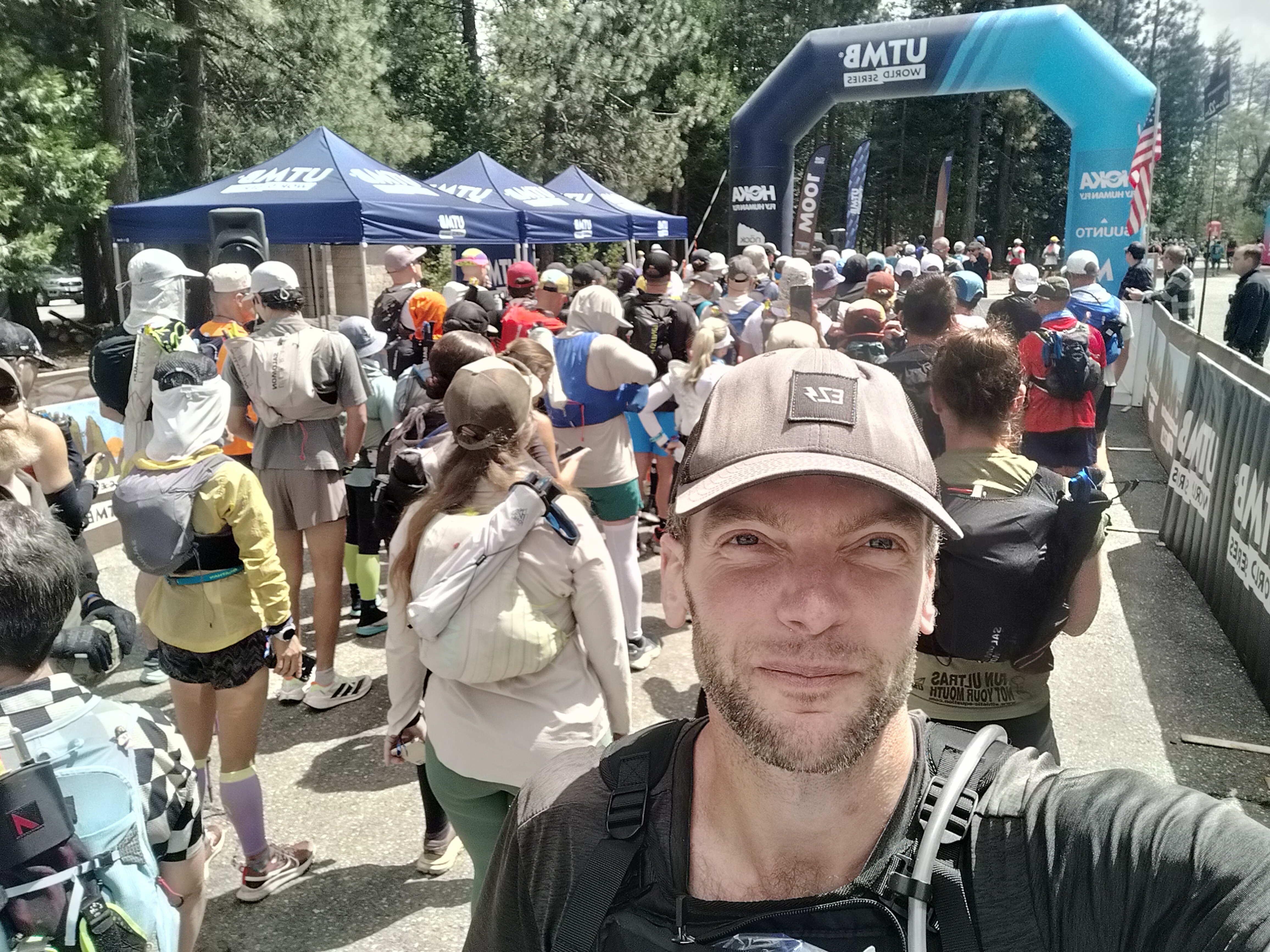
This is guidance for Mike, from future Mike. ...A few days after attempting his first 100-mile trail race — the Canyons Endurance race, in the Placer County foothills near Auburn. (This race's course overlaps a lot with the Western States course... that's a go-to race for the fastest 100-mile runners in the world... fun to share those trails.)
Hey Mike,
In three months, you'll try your first 100-mile trail race.
You're assuming that you should play the long game with this race... don't push too hard in the first 50 miles. You're assuming it's a good idea to power hike (i.e. fast walk) all the significant uphills. ...That it's okay to take 5-10 minutes at aid stations. ...Strech a bit. Put more salve on your toes. Sit down with food.
You can't do that.
You think the problem could be: Your body has become so tight and the pain has become so crushing... that you're reduced to a slow hobble (or sucking your thumb in some bushes).
You'll have 35 hours to get across the finish line. But there are shorter cut-off times at aid stations.
At the 46-mile aid station, you were surprised to hear that you arrived only four minutes inside the cut-off time (and you were rushed by the station crew, because you have to leave before the cut-off time).
You picked up the pace, and assumed you'd get to the next (54-mile) aid station comfortably before its cut-off time (5:30am). You got there two minutes past the cut-off time. The aid-station crew was kind, but not merciful. They asked for your bib, and directed you to the loser van.
I know you like flying blind... not paying attention to time or tracking your pace. Forest Gump. You can't do that in a 100-mile race. At least, you need to set goals for how much cut-off-time buffer to maintain throughout the race. Use a watch.
From the 37-mile station to the 46-mile station... you were on the struggle bus. You were going slow, because that hurt less. You fast walked some gradual uphills.
But then you got hit with the cut-off-time warning, and you jumped into a reasonable pace. And you felt better again. There will be emotional ups and downs, but you need to ride the downs at a reasonable pace.
In your last eight-mile leg, you had mostly transcended the pain. It sort-of became the baseline experience. You focused more on the strength still in your legs. ...The pain became more superficial and the strength became core. Practice this headspace.
Coming into that last aid station... you were feeling really good. ...Stoked that at that point you had run farther than ever before... stoked to finish the race. ...Remember that the downs will pass.
Your normal weekend trail loop is around 13 miles. At your normal pace (with your drinking-fountain hangouts), you don't have the pain / opportunity to practice. And you generally don't have time for much longer runs. Yesterday, you ran the loop faster than you've ever run trails before. Your stomach started hurting a ~mile in (like the doing-sit-ups hurt). Two quick fountain sips and two quick pees. You finished the loop just under two hours. ...You need to track your times with this loop, and you need to push yourself. Build fortitude.
Make the day before the race easy and calm. Good on you for your past-due relative visit — a very good dude, a very hard sitch — but don't schedule stuff like that for the day before. Be meditating on the race, solo. Ideally in Auburn, with a rented room.
Thanks to another relative for very graciously hosting the night before in Sacramento. Thanks for giving a delicious nutritious dinner. In her steam room shortly before sleep... you felt weaker than you've felt in a long time. You didn't have the will to hold yourself upright. Not good.
(BTW: Be in a better emotional place for the race by generally practicing better discpline and prioritization.)
At basecamp the day before, you watched a physical therapist demonstrate putting KT tape on a foot. It takes some practice / skill to do it right (where it doesn't bunch up, and make things worse). You bought some KT tape. Right before the race, you put it on. You thought you did a pretty good job. Shortly into the race, it was bunching up on one foot and you took it off. Then the other foot.
Dude: Figure this out on practice runs, not the 100-mile race. Or skip it, and accept that blisters are part of the experience.
In general, don't try new things on race day.
Without the KT tape, you were concerned about toe blisters. At most aid stations, you put salve ("squirrel nut butter") around your toes. This took too much time.
But toe blisters did start around mile 50 (no blistering or chafing elsewere (good job covering your nipples)).
A basecamp speaker said that footcare should start in the weeks before the race (not the day before). Lotion, callus management, etc. Learn more.
You crossed creeks over 20 times. You needed to walk thru water two of those times. You took your shoes and socks off. Most or all other runners didn't. To reduce blisters: This might be the one time it's reasonable to take shoes and socks off (your socks went back on over wet feet quickly). This can be the one time where you put more salve on your toes.
Take advantage of the opportunity to have a drop bag delivered to an aid station, with a few layers for night running. Having a long-sleeve shirt and jacket around your waist the whole time... not a big deal, but don't do it.
The Shokz "bone conduction" running headphones are great. Make sure you have those.
But don't plan to listen to stuff in the first 50 miles. You're mostly on singletrack trails, and there are usually other runners nearby (there's clumping). You need to listen for runners looking to pass, and give them the opportunity.
Don't worry about being bored. It's a race and you'll be hyped. You weren 't bored at all over the 17.5 hours.
It did thin out later in the race. In the last 8-mile leg... you would sometimes go a few miles without other runners around. You put on music (e.g. Kid A), and it helped a lot. Have albums ready for the second half. ...Tried-and-true albums, because it's not a time to be on your phone skipping around.
There was a lot of poison oak this year. It was growing over the trail all over the place. Everyone just ran thru it. At the basecamp, you got pre-exposure / post-exposure packets. You used them, and you barely got poison oak. Use the packets.
It did you good to be amongst these hardcore super-fit people. Race results are here. The winner's time was 17 hours 50 minutes. Any guy that thinks women are weak or older people are weak... shut the fuck up bro. The second-place runner is a 46-year-old woman. Five out of the top ten — women. The number-13 runner... a 56-year-old man.
Everyone at the aid stations... so kind, so supportive. Those aid stations were forest-party spots (which made it more compelling to hang out, but don't). And the other runners... so kind, so supportive. It's a rad community. You were in good hands.
Special thanks to runner Ben, who sat with me on the shuttle and gave me super-thoughtful guidance based on his past 100-mile races.
I really appreciate all the love and props I've gotten from friends and family. Thank you.
I need to step up my game so I can properly afford the ~$500 registration fee, one-night's stay, etc.
With that said...
I'm really excited to try this again next Spring. I'll finish the race.